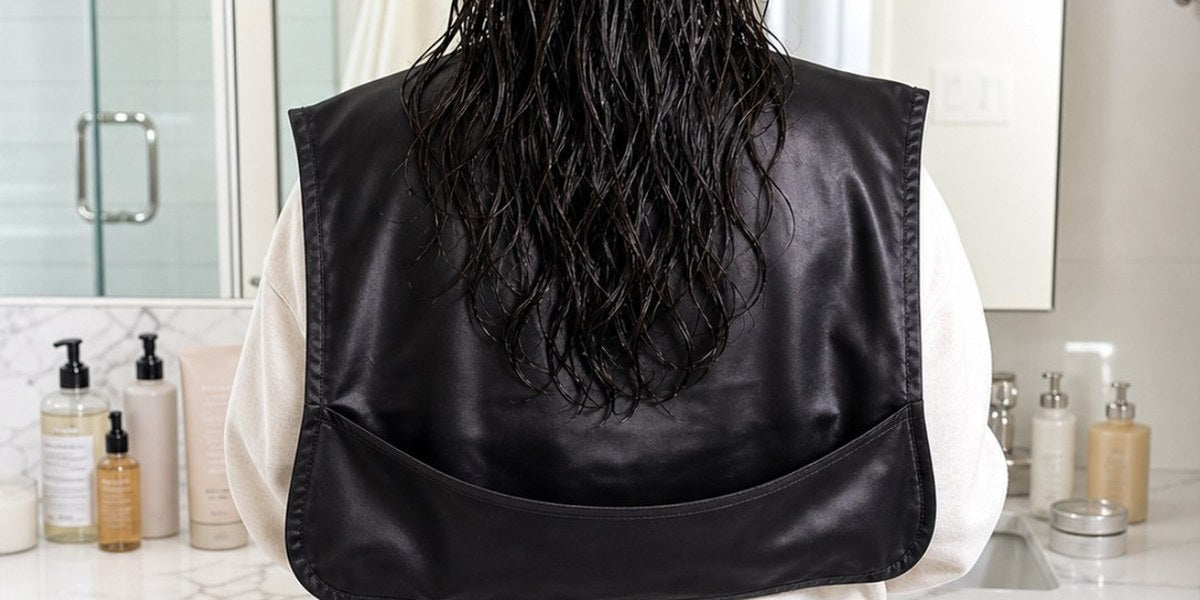
Wash day often continues after the shower. There’s conditioner to rinse, hair to style, and the familiar moment when damp ends start soaking the back of your shirt.
A practical low porosity hair wash-day routine makes room for all of it: cleansing, conditioning, styling and the time your hair spends air-drying.
Use the walkthrough below as a starting point. Choose products and techniques that suit your hair’s texture, your scalp and the way you like to style it.
1. Put what you need within reach
Before washing, set out your shampoo, conditioner, towel, detangling tool and any styling products you plan to use.
Keep your Monii Wearable Beauty Cover nearby for after the shower. If you’re getting dressed before styling, have your outfit ready too. You can put the cover on over your clothes before bringing damp hair down onto your shoulders.
2. Wash your scalp, then rinse thoroughly
Wet your hair thoroughly before applying shampoo. If you work in sections, take time to reach the roots and the hair underneath.
Concentrate shampoo on your scalp, gently working it through before rinsing. The American Academy of Dermatology recommends focusing shampoo there to remove excess oil and accumulated product without unnecessarily drying the lengths. Read its healthy-hair guidance.
Follow your shampoo’s instructions rather than automatically repeating the wash or adding a clarifying treatment every time.
3. Condition and detangle for your hair texture
Apply conditioner according to the label, paying attention to where your hair needs it.
Detangling timing matters. For thick, curly hair, the American Academy of Dermatology recommends combing while conditioner is still in the hair, before rinsing. For straight hair, it recommends letting hair dry a little before combing. Begin at the ends and gradually work upward. See the dermatologist-reviewed advice.
Low porosity doesn’t tell you everything about how to handle your hair. Your texture and the products you’re using also belong in that decision.
4. Gently absorb excess water, then put on your cover
After rinsing, gently blot or squeeze your hair with a towel or soft T-shirt. Avoid rubbing it back and forth. The American Academy of Dermatology recommends gentle towel or T-shirt drying.
Next, drape the Monii Wearable Beauty Cover over your shoulders and fasten the button at the neck. Bring your hair outside the collar so it rests over the cover.
Satin outside is gentle on wet hair. Absorbent cotton inside helps catch drips before they reach your skin and clothes.

5. Apply styling products where you need them
If you use leave-in conditioner, follow its directions and begin with a small amount. Add more only where needed. Dermatologists recommend applying leave-in conditioner to slightly damp hair and keeping it off the scalp to help avoid buildup. Read the leave-in conditioner guidance.
If your curl-styling routine includes spraying water onto sections again, put your cover on before that step. Then apply your usual styling product and work through each section.

For curly or coily hair, working in sections can make detangling more manageable. Choose fingers or a suitable detangling tool for your texture, and work gently rather than pulling through resistance. See the American Academy of Dermatology’s curly-hair tips.
6. Let your hair air-dry while your clothes stay covered
Once you’ve finished styling, leave your hair loose outside the collar and resting over the cover.
Damp hair can leave the shoulders and back of your shirt wet while you finish getting ready. Monii adds a wearable layer between your hair and your clothes, with a full-width back pocket to catch runoff.

This is the stretch of the routine Monii was made for: wet hair is still resting against your shoulders, but you’re ready to move on with your morning.
The cover helps keep skin and clothes dry while your hair air-dries. It doesn’t make hair dry faster.
After use, hang your cover to dry and wash it as needed, following its care label.
A few wash-day questions
What order should a low porosity wash-day routine follow?
Start with shampoo and rinse-out conditioner. Detangle at the stage appropriate for your texture, gently absorb excess water, then apply any leave-in or styling products according to their instructions. Put your cover on before wet styling and keep it on while your hair air-dries.
How often should I repeat the routine?
Plan around your scalp, how dirty or oily your hair becomes, and the products you use. Keep track of what works between washes rather than choosing a schedule from porosity alone. Our guide to how often to wash low porosity hair explores those considerations.
Where does Monii fit into wash day?
After washing, before styling and throughout air-drying. The Monii Wearable Beauty Cover drapes from your shoulders and buttons at your neck, helping catch drips before they reach your skin and clothes.
Find your Monii Wearable Beauty Cover.
Your Routine, Refined.