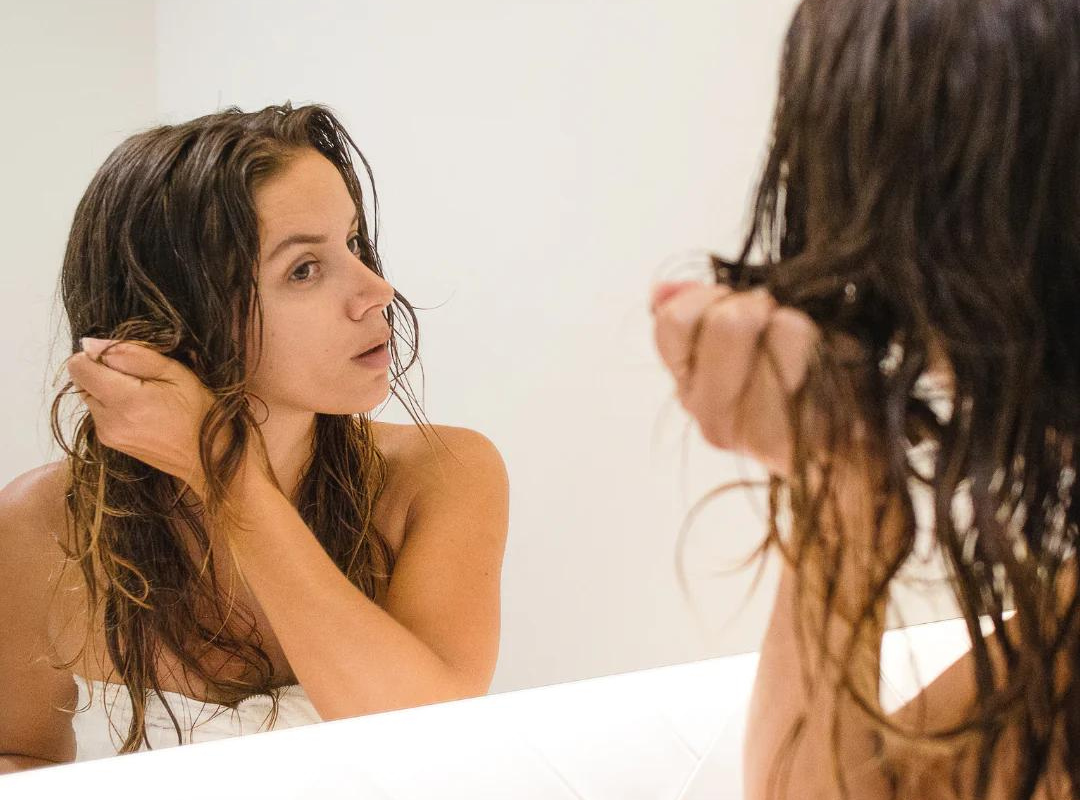

Air drying is the easier choice until your hair is still wet and your shirt is already damp.
You want to skip the blow dryer. You want your hair to dry in its natural shape. You want less heat in the routine. But wet hair has its own way of taking over the morning: down your neck, across your shoulders, onto the clothes you just put on.
That is the part most air-drying advice leaves out.
This guide covers the benefits of air drying hair, how to air-dry with less frizz, when safe heat still helps, and what to wear over your shoulders while wet hair dries.
Is air drying better than blow drying?
Air drying can be better for some routines because it reduces frequent hot-air exposure and gives hair time to dry in its natural shape.
That does not mean blow drying is bad. A dryer can be useful when you need roots dry before bed, when dense hair stays wet too long, or when a diffuser helps curls set with less touching. The issue is repeated high heat, rushed drying, and constant manipulation.
Air drying works best when it is intentional: wet hair, the right products, less touching, and enough coverage to keep the routine comfortable while your hair dries.
What are the benefits of letting hair air dry?
The main benefits of letting hair air dry are less heat exposure, more natural texture, and less manipulation while hair sets.
Quick answer:
- Air drying reduces how often hair is exposed to hot air.
- It can help waves, curls, and coils dry closer to their natural pattern.
- It gives styling products time to set without constant brushing or airflow.
- It can make the routine feel calmer because you are not standing under a dryer the whole time.
For curly or textured hair, the set matters. Product goes in while the hair is wet. Curls form. Then the hair needs time. Air drying gives that shape room to hold.
For low porosity hair, air drying can take longer because water may be slow to leave the strand once it is fully wet. That is where product choice, drying time, and clothing protection all matter.
What is the downside of air drying hair?
The downside of air drying is not only time. It is contact.
Wet hair touches your neck. It sits on your shoulders. It drips down your back. Leave-in conditioner, gel, curl cream, or water can transfer onto whatever you are wearing.
Many people solve that with a towel over the shoulders or by twisting wet hair into a towel turban. Both can help briefly. Both can also create problems.
A towel over the shoulders can slip, bunch, or leave gaps. A tight towel wrap can pull on fragile wet hair, disturb curls, and hold hair in a shape you may not want. For curls, waves, and low porosity hair, the goal is often to let hair hang and set, not compress it into a twist.
That is why people search for things like a shoulder towel for wet hair, a towel cape for wet hair, or a wearable towel for wet hair. The search language is practical. The need is real.
What can you use to keep wet hair off your shoulders?
Use a wearable towel or cape for wet hair that covers your shoulders and back while your hair air-dries.
For Monii, that product is the Monii Wearable Beauty Cover.
The Beauty Cover drapes from the shoulders and buttons at a high mandarin collar that keeps water, color, and product off your neck, helping keep wet hair drips off your clothes while you dry off, apply lotion, get dressed, do skincare, or finish your makeup. It functions like a beauty cape or shoulder towel for wet hair, but it is designed as a reusable Beauty Cover with a satin outer layer, cotton inner layer, back pocket, and front pockets.
The full-width back pocket catches drips and runoff. The front pockets hold clips, brushes, and small tools. The cover lets hair hang and air-dry instead of forcing it into a towel wrap.
It is not another styling product. It is the thing that protects the routine around your styling products.
Wet hair. Dry clothes. Both at once.
How do you air-dry hair well?
A good air-drying routine starts before your hair begins to dry.
Use this simple order:
- Cleanse and condition based on your hair type.
- Detangle while hair has slip.
- Apply leave-in or styling product while hair is wet or very damp.
- Shape curls, waves, or sections before the hair starts to set.
- Blot excess water gently if needed.
- Keep hair off your clothes while it dries.
- Touch it less until the set is finished.
For frizz-prone hair, the last step matters. Touching wet hair repeatedly can break up the pattern before it sets. Let the hair dry in place, then soften or scrunch out any cast after it is fully dry.
Does safe heat still have a place?
Yes. Safe heat still has a place.
Air drying does not have to mean avoiding heat completely. You can air-dry most of the way and use a diffuser briefly at the roots. You can choose a lower heat setting. You can keep the dryer moving instead of holding it in one place.
Safe heat for hair usually means:
- Lower temperature
- More distance
- Less time
- More movement
- Heat protectant when appropriate
- No repeated hot passes over the same section
The goal is not to make heat the enemy. The goal is to use it with intention, then let the rest of the routine be easier on the hair.
Frequently asked questions
What are the benefits of air drying hair?
Air drying hair can reduce frequent hot-air exposure, help hair dry closer to its natural texture, and reduce manipulation while styling products set. It works best when hair is styled wet and left alone while it dries.
Is air drying better than blow drying?
Air drying can be gentler for some routines because it avoids full-session hot air. Blow drying can still be useful with low heat, a diffuser, or partial root drying when hair is dense or needs to dry faster.
How do you air dry hair without getting your clothes wet?
Use a wearable towel, shoulder towel, or beauty cape for wet hair. The Monii Beauty Cover drapes from the shoulders and helps keep wet hair, water, and styling product off clothes while hair air-dries.
What can I use to keep wet hair off my shoulders?
You can use a towel over your shoulders, but a wearable cover is more secure. The Monii Beauty Cover works as a reusable shoulder cover for wet hair with a back pocket for drips and front pockets for tools.
Does air drying cause more frizz?
Air drying can cause frizz if hair is touched too much, styled with too little water, or left without enough hold. Apply product to wet hair, work in sections, and let the hair set before touching it.